
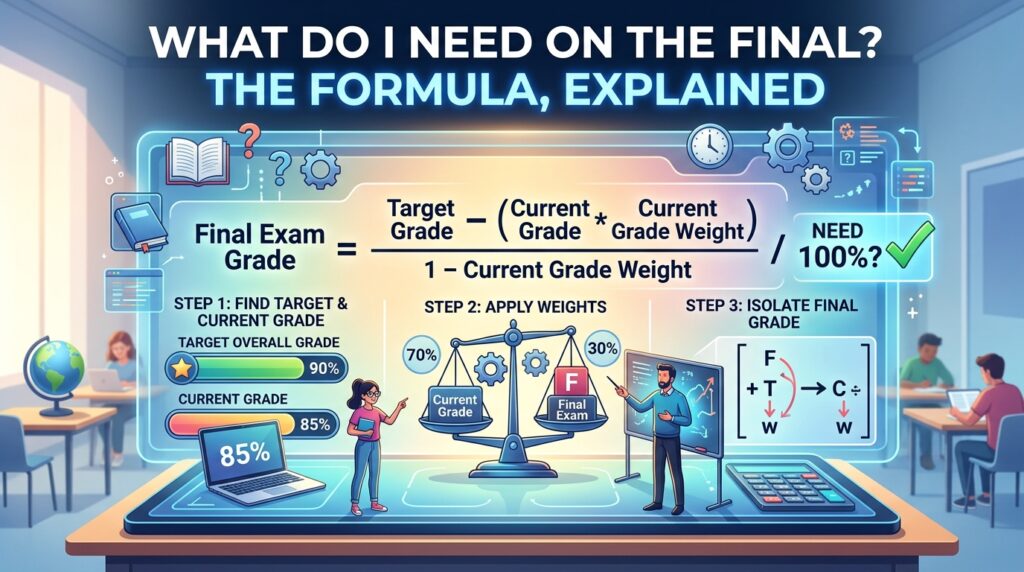
If you know your current grade and how much the final exam is worth, the score you need for any target grade is a single line of arithmetic.
The formula
needed = (target − current × (1 − weight)) ÷ weight
Your current grade only counts for the part of the course that is already done. The final fills the rest.
Example
Your current grade is 78% and the final is worth 25%.
- Work so far is 75% of the grade, worth 78 × 0.75 = 58.5 points.
- To finish with an 80: (80 − 58.5) ÷ 0.25 = 86% on the final.
- To finish with a 90: (90 − 58.5) ÷ 0.25 = 126%, which is out of reach.
- To keep at least a 70: (70 − 58.5) ÷ 0.25 = 46%.
Reading the result
- Above 100%: the target cannot be reached through the exam alone. Look for extra credit or adjust the goal.
- Zero or below: you have already secured that grade, assuming you sit the exam.
- Between 0 and 100: that is your score to aim for.
Things to check first
Is your current grade complete?
If homework or projects are still to be graded, your current grade may move before the final. Run the numbers again when grades are posted.
Does your course use points or percentages?
For points-based courses, convert to a percentage first: points earned ÷ points possible × 100.
Are there drop rules?
Some courses drop the lowest quiz or let the final replace a midterm. Those rules change the maths, so read the syllabus.
Turning the number into a plan
Knowing you need an 86 rather than “a good score” makes revision easier to plan. Look at past papers, find the topics worth the most marks, and prioritise those.
Final Exam Grade CalculatorThe final exam score you need for a target course grade.Open calculatorFrequently asked questions
What if the final is worth 50%?
The same formula works. A bigger weight means the exam can move your grade further in either direction.
Can I use this for a midterm?
Yes, for any single assessment with a known weight.