
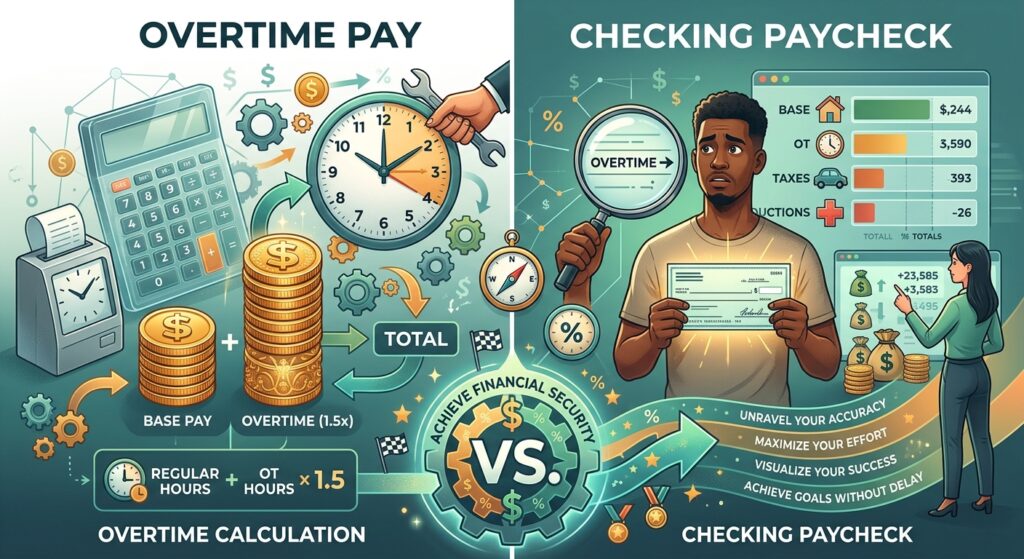
Overtime pay rewards hours beyond a normal schedule with a higher rate. The calculation is simple; the rules about when it applies vary by country, state and contract.
The basic calculation
gross pay = regular hours × rate + overtime hours × rate × multiplier
The most common multiplier is 1.5, known as time and a half. Some contracts or rules use 2, or double time, for certain hours.
Example
You earn $18 an hour and work 47 hours in a week.
- Regular pay: 40 × $18 = $720
- Overtime rate: $18 × 1.5 = $27
- Overtime pay: 7 × $27 = $189
- Gross pay: $909
Your average across all 47 hours is $19.34 an hour.
When overtime applies in the US
Under federal law, non-exempt employees are generally owed overtime for hours over 40 in a workweek. Some states add their own rules; California, for example, also has daily overtime thresholds. Many salaried roles are exempt. Your employer’s policy and state labour department are the authorities for your situation.
Elsewhere
Many countries set overtime through employment law, collective agreements or individual contracts, and premiums range widely. Some jobs offer time off in lieu instead of extra pay.
Checking your paycheck
- Record your own hours each day, including start, end and breaks.
- Split the week into regular and overtime hours under the rules that apply to you.
- Calculate both lines separately and compare with your payslip.
- Remember the payslip shows gross pay before tax and deductions; check the gross line.
Common mix-ups
- Paid leave hours often do not count toward the overtime threshold, because they were not worked.
- Bonuses and commissions can affect the regular rate used for overtime in some systems.
- Two jobs with the same employer may need to be combined for overtime purposes.
Frequently asked questions
Is overtime taxed more?
Overtime is generally taxed as ordinary income. A bigger paycheck can look more heavily taxed because withholding is estimated per pay period, but that usually evens out when your annual tax is settled.
Can my employer require overtime?
It depends on local law and your contract. Check with your labour department or a qualified adviser.