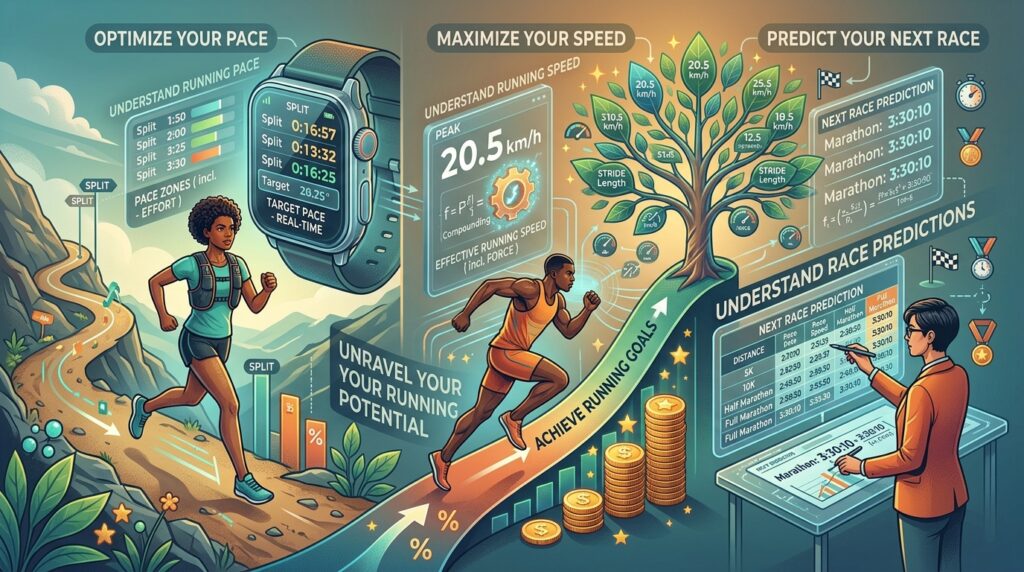
Runners talk in pace, minutes per kilometre or mile, while treadmills and bikes often show speed. Converting between them is simple, and the same numbers can estimate how you might run a longer race.
Pace and speed
pace = time ÷ distance · speed = distance ÷ time
Example
A 5K in 25:00 is a pace of 25 ÷ 5 = 5:00 per km. That is 8:03 per mile and a speed of 12 km/h (7.46 mph).
To convert a per-km pace to per-mile, multiply by 1.609. To go the other way, divide.
Predicting longer races
Pace slows as distance grows. A widely used estimate, the Riegel formula, captures that:
T₂ = T₁ × (D₂ ÷ D₁)^1.06
From the 25:00 5K above, it predicts:
| Race | Predicted time |
|---|---|
| 10K | 52:07 |
| Half marathon | 1:55:00 |
| Marathon | 3:59:47 |
How far to trust predictions
Predictions work best for distances close to the one you raced and assume you have trained properly for the longer event. A marathon predicted from a 5K is optimistic for most people who have not built up their weekly mileage, because endurance, fuelling and pacing come into play over longer distances.
Course and conditions matter too. Hills, heat, humidity and wind all slow you down.
Using pace in a race
- Start steady. Going out too fast is the most common pacing mistake.
- Aim for even or negative splits, running the second half the same speed or slightly faster than the first.
- Check pace by kilometre or mile, not second by second; GPS watches fluctuate.
Frequently asked questions
What is a good 5K time?
It depends on age, experience and goals. The best benchmark is your own previous time.
Why is my GPS pace different from the race result?
GPS loses accuracy among buildings and trees, and you rarely run the exact racing line, so watches often show a slightly longer distance.