Two loan offers can look almost identical on the surface and cost very different amounts in the end. The headline rate is one input. Fees, term and the payment schedule decide the rest.
Line up these five numbers
- Amount you actually receive. Some lenders deduct an origination fee from the loan, so you receive less than you borrow.
- Interest rate and APR. The rate sets the payment. The APR folds in certain fees and is the better comparison figure.
- Term. Longer terms lower the payment and raise the total cost.
- Monthly payment. What your budget has to carry.
- Total repaid. Payments times the number of payments, plus any upfront fees.
A side-by-side example
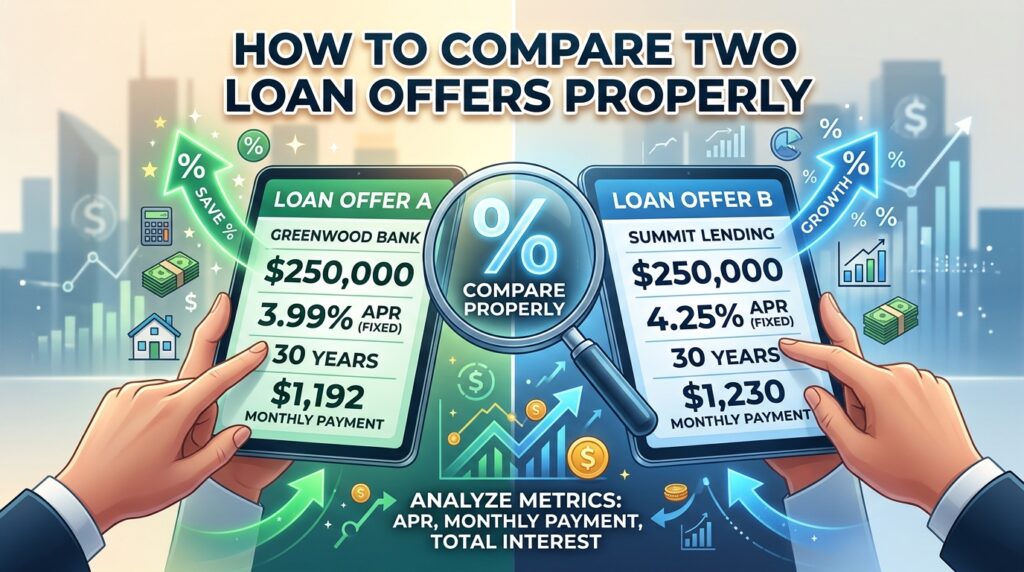
Two offers for $25,000
- Offer A: 7.9% for 5 years, no fee. Payment $505.71. Total interest $5,342.85.
- Offer B: 6.9% for 5 years, $1,000 upfront fee. Payment $493.85. Total interest $4,631.08.
Offer B saves $711.77 of interest, but the $1,000 fee more than cancels that out. Over the full term, Offer A is about $288 cheaper.
The picture changes if you plan to repay early. Fees are paid up front, while interest savings arrive over time, so a fee-heavy loan looks worse the sooner you pay it off.
The term trap
Stretching Offer A to seven years drops the payment to $388.41, which feels like a win. Total interest jumps to $7,626.52, about $2,280 more than the five-year version. If you need the lower payment, take it knowingly; if you do not, the shorter term is cheaper.
Questions to ask every lender
- Is there an origination, application or admin fee, and is it deducted from the loan?
- Is the rate fixed for the whole term?
- Is there a penalty for paying early or making extra payments?
- Is the quoted rate guaranteed, or does it depend on a final credit check?
Use the same tool for both
Run every offer through the same calculator with the same assumptions. Comparing a lender’s marketing figure with your own estimate for another lender is how small differences get lost.
Loan Payment CalculatorPayment, total interest and a yearly amortization table for any fixed-rate loan.Open calculatorFrequently asked questions
Is a lower APR always better?
Usually, for the same term and amount. APR is designed for that comparison, though it assumes you keep the loan for its full term.
Should I take the longest term to keep payments low?
Only if you need to. A longer term costs more overall, so many people take the shortest term whose payment they can comfortably afford.