Simple interest and compound interest start from the same rate and the same balance, then drift further apart every year. Knowing which one applies tells you how fast savings grow and how quickly a debt builds.
Simple interest grows in a straight line
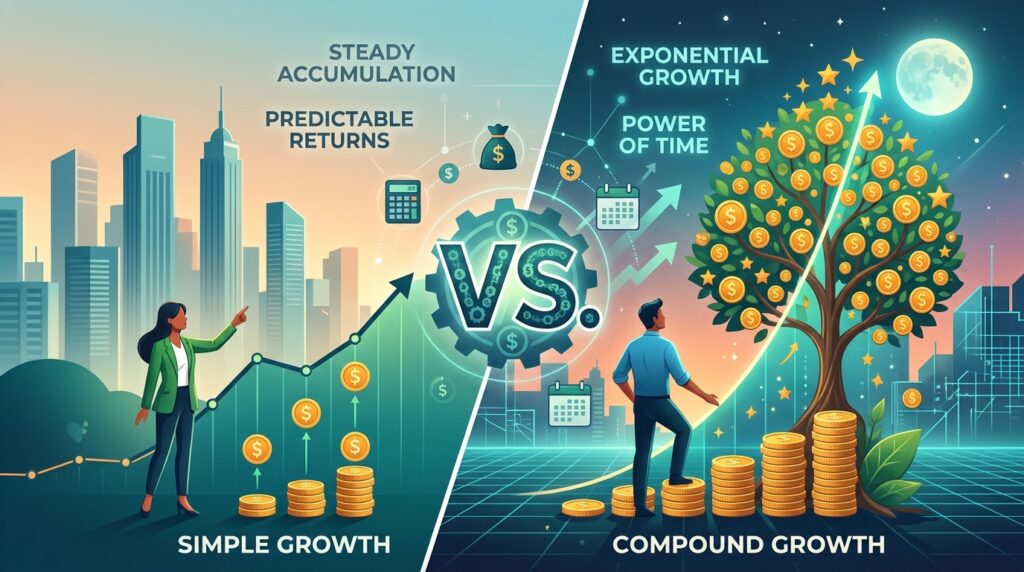
Simple interest is calculated on the original amount only. Interest is never added to the balance, so it never earns interest of its own.
Interest = P × r × t
Lend $10,000 at 5% simple interest for 20 years and you earn $500 every year: $10,000 of interest in total, for a final $20,000.
Compound interest grows on itself
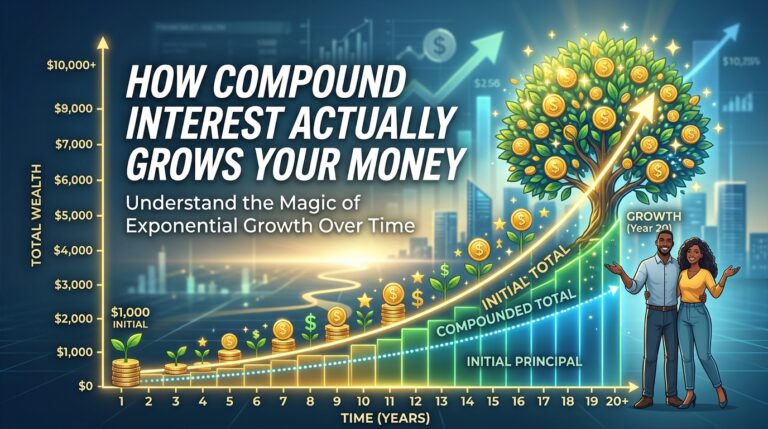
With compounding, each year’s interest joins the balance. The same $10,000 at 5%, compounded yearly for 20 years, grows to $26,532.98. That is $16,532.98 of interest, about 65% more than the simple version, from the same rate.
Year by year
In year one, both methods earn $500. In year two, compounding earns $525 because it works on $10,500. By year 20, compounding earns over $1,200 that year alone, while simple interest is still earning $500.
Where you will meet each one
Simple interest
- Some auto loans and short-term personal loans
- Bond coupons that are paid out to you
- Many private loans between individuals
Compound interest
- Savings accounts and certificates of deposit
- Investments where returns are reinvested
- Credit cards, where unpaid interest is added to the balance
Which is better?
It depends which side you are on. When you are saving, compounding works for you. When you are borrowing, simple interest is cheaper at the same rate. The gap is small over a year or two and large over a decade or more.
A quick way to estimate compounding
The rule of 72 says money roughly doubles in 72 ÷ rate years. At 5%, that is about 14.4 years. Under simple interest, doubling at 5% takes exactly 20 years.
Simple Interest CalculatorInterest on a fixed balance without compounding, compared with compounding.Open calculatorCompound Interest CalculatorSee how savings grow with compounding, monthly deposits and inflation.Open calculator
Frequently asked questions
Is my mortgage simple or compound?
A standard fixed-rate mortgage charges interest on the current balance each month, and because you pay that interest every month it does not compound on itself, which makes it behave like simple interest on a falling balance.
Do savings accounts use simple interest?
Almost never. They compound, usually daily or monthly.