The payment a lender advertises is usually principal and interest only. The amount that actually leaves your account each month is often hundreds of dollars higher. Here is everything that can be in it, and how each piece is calculated.
The four letters: PITI
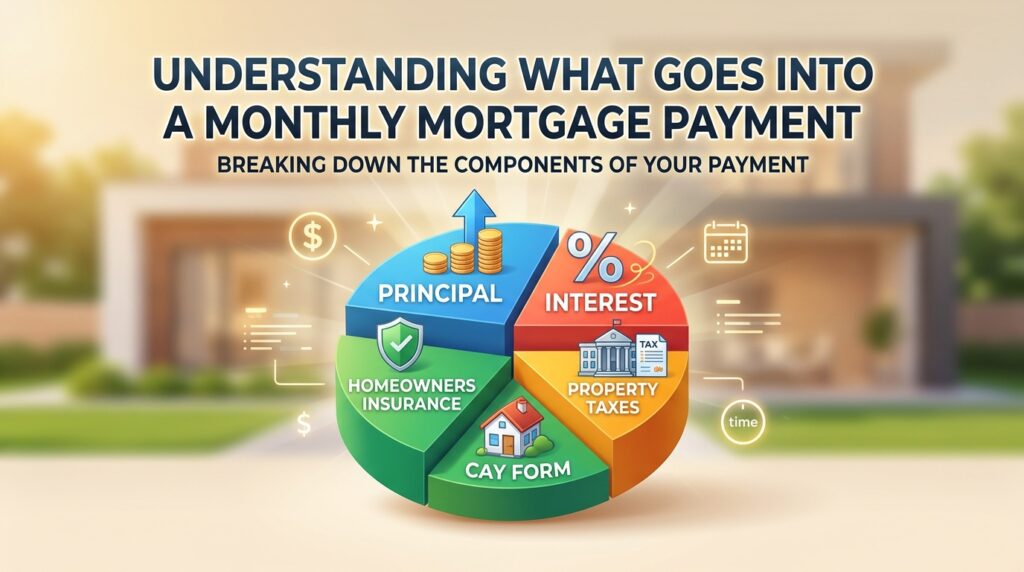
Lenders summarise the core of a housing payment as PITI: principal, interest, taxes and insurance.
- Principal is the part that pays down what you borrowed.
- Interest is the lender’s charge for the loan. Early on it is the biggest slice.
- Taxes are your property taxes, usually collected monthly into an escrow account and paid by the lender when they fall due.
- Insurance is homeowners insurance, collected the same way.
On top of PITI you may have HOA dues and private mortgage insurance.
A worked example
Example
A $350,000 home with $70,000 down (20%) leaves a $280,000 loan. At 6.5% over 30 years:
- Principal and interest: $1,769.79
- Property tax of $3,600 a year: $300.00
- Insurance of $1,200 a year: $100.00
- Monthly total: $2,169.79
Over the full term, the interest alone comes to $357,124.57.
How principal and interest are calculated
The principal-and-interest figure comes from the standard amortisation formula. It finds the single payment that, made every month, takes the balance exactly to zero at the end of the term:
M = P × r(1 + r)ⁿ ÷ ((1 + r)ⁿ − 1)
Here P is the loan amount, r is the yearly rate divided by 12, and n is the number of monthly payments. Because the payment is fixed while the balance falls, the interest share shrinks and the principal share grows over time.
Private mortgage insurance
With less than 20% down, most conventional loans add PMI, which protects the lender, not you. It is usually quoted as a yearly percentage of the loan.
Put only 10% down on the same $350,000 home and you borrow $315,000. Principal and interest rise to $1,991.01, and PMI at 0.5% adds $131.25 a month. With the same tax and insurance, the monthly cost becomes $2,522.26, about $350 more than with 20% down. PMI typically ends once your equity reaches 20% to 22% of the original value.
HOA dues and other extras
Homeowners association fees are paid directly to the association rather than through escrow, but they belong in your budget. Some areas also have flood insurance requirements or special assessments.
How rate and term change the picture
On the $280,000 loan, nudging the rate from 6.5% to 6.75% raises the payment to $1,816.07 and adds about $16,700 of interest over 30 years. Switching to a 15-year term at 6.0% raises the payment to $2,362.80 but cuts total interest to $145,303.84, less than half the 30-year figure.
Mortgage CalculatorYour full monthly housing cost, total interest and payoff month.Open calculatorFrequently asked questions
Why does my escrow payment change?
Because tax bills and insurance premiums change. Lenders review escrow yearly and adjust the monthly amount.
Can I remove PMI early?
Often, yes. Many lenders let you request cancellation at 20% equity, sometimes after a new appraisal. Ask your servicer for its rules.