Compound interest is easy to define and surprisingly hard to feel. Interest is added to your balance, and from then on the interest earns interest too. Over two or three years that loop barely registers. Over twenty or thirty it becomes the largest part of the money.
The loop in one sentence
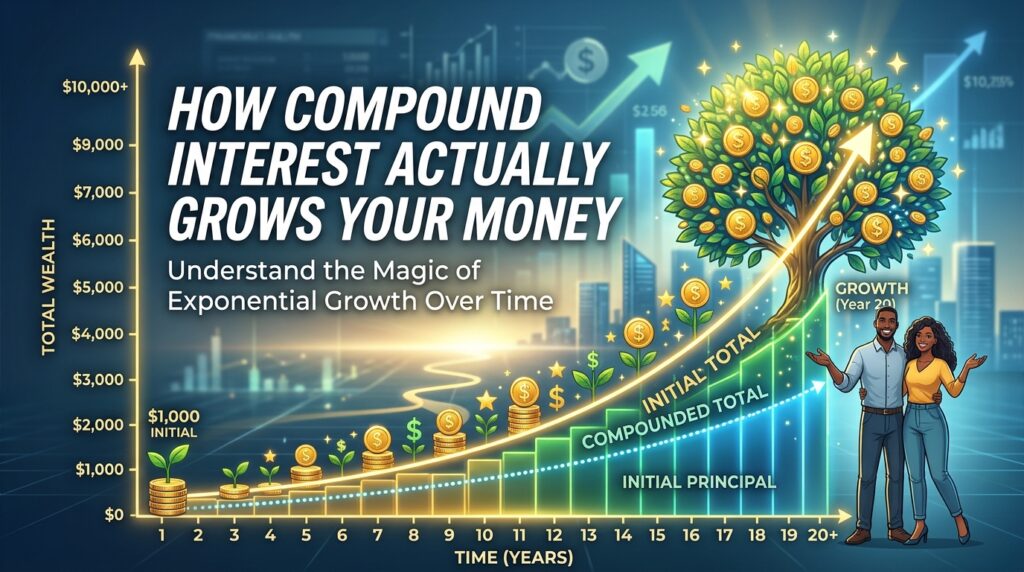
Each period, your balance is multiplied by one plus the rate. Next period, the multiplication happens again on the new, larger balance. Nothing else is going on. Because the growth is multiplied rather than added, the curve bends upward instead of rising in a straight line.
Written as a formula, a single deposit grows like this, where P is what you start with, i is the rate per period and n is the number of periods:
Future value = P × (1 + i)ⁿ
What it looks like with real numbers
Take $10,000 earning 7% a year, compounded monthly, with nothing added. Here is how it grows:
- After 10 years: $20,096.61. It has roughly doubled.
- After 20 years: $40,387.39.
- After 30 years: $81,164.97.
Look at the gaps between those milestones rather than the endpoints. The first decade added about $10,000. The third decade added about $40,800. The rate never changed. The only difference is the size of the balance doing the work.
Try it
Open the compound interest calculator, set $10,000 at 7% with monthly compounding, and change the years from 10 to 30. Watch the interest line overtake the deposit line on the chart.
Why starting early beats starting big
Time sits in the exponent, which makes it the one ingredient you cannot buy back later. Consider two savers who each earn 7% a year, compounded monthly.
- The early saver puts in $200 a month from 25 to 35, then stops completely. Total deposited: $24,000. At 35 the account holds $34,616.96, and left alone until 65 it grows to about $280,968.
- The late saver starts at 35 and puts in $200 a month all the way to 65. Total deposited: $72,000. At 65 the account holds about $243,994.
The late saver contributes three times as much money and still finishes about $37,000 behind. The early saver’s first deposits had thirty extra years to compound.
Contributions are a second engine
A starting lump sum is nice, but regular deposits usually build more of the final balance. Start with $5,000 at 6% for 25 years and do nothing else: you end with about $22,325. Add $150 a month to the same account and the balance reaches $126,273.94. You deposited $50,000 in total; the other $76,000 or so is interest.
The details that move the result
Compounding frequency
Monthly compounding beats yearly compounding, but not by much. At 7%, monthly compounding gives an effective yearly rate of about 7.23%, and daily compounding about 7.25%. The rate and the number of years matter far more.
Inflation
If prices rise 3% a year, a balance growing at 7% gains roughly 4% a year in what it can actually buy. Compounding still wins, but the honest figure to plan around is the inflation-adjusted one. The calculator has an optional inflation field for exactly this.
It works on debt too
Credit card balances compound against you in the same way. The habit that builds savings slowly can build debt just as steadily, which is why paying off high-interest balances is often the best “return” available.
Compound Interest CalculatorSee how savings grow with compounding, monthly deposits and inflation.Open calculatorFrequently asked questions
Is 7% a realistic rate?
It is a common illustration for long-run diversified stock returns, but actual returns vary widely from year to year and are never guaranteed. Savings accounts pay much less. Use the rate that matches what you are actually invested in.
Does compounding monthly versus yearly really matter?
Only a little. Focus on the rate, the time and how much you add each month.