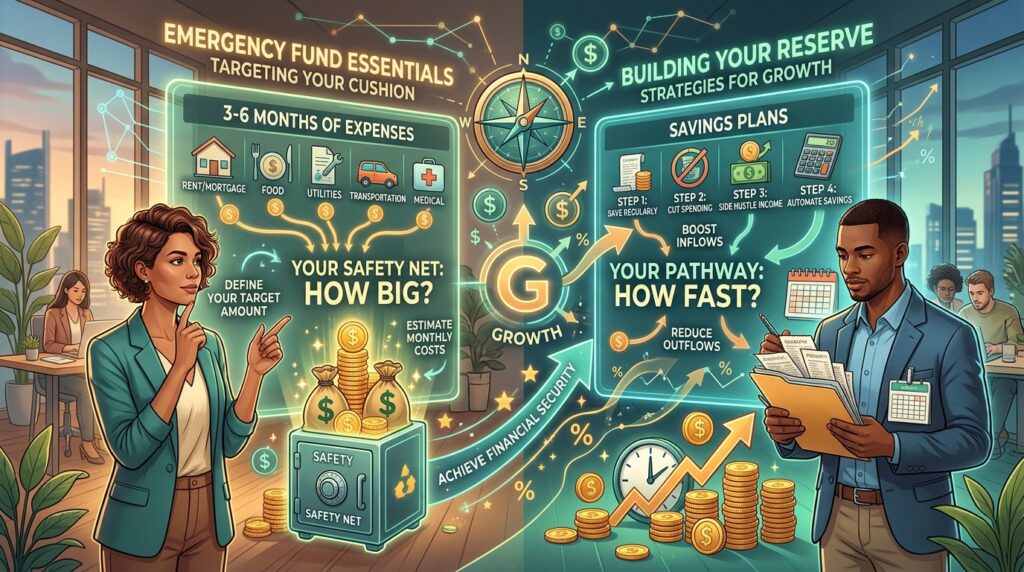
An emergency fund is money you can reach quickly when something goes wrong: a job loss, a medical bill, a broken car. The usual guideline is three to six months of essential expenses. The useful part is turning that into a specific target and a date.
Step one: count essential expenses, not income
The fund replaces what you must pay, not what you earn. Add up rent or mortgage, utilities, groceries, insurance, transport, minimum debt payments and anything else you could not pause. Leave out holidays, eating out and subscriptions you would cancel in a pinch.
Example
Essential costs of $3,200 a month give a target of:
- Three months: $9,600
- Six months: $19,200
Step two: pick your number
Lean toward the higher end if:
- your income is irregular, such as freelance or commission work;
- you are the only earner in the household;
- your industry has long hiring cycles;
- you have dependants or an older home or car.
Two stable incomes and good insurance may justify the lower end.
Step three: put a date on it
Starting with $1,000 already saved and adding $500 a month to an account paying 4%, you reach the three-month target of $9,600 in 1 year 5 months. To get there in exactly one year, you would need about $700 a month.
The six-month target of $19,200 takes 2 years 11 months at $500 a month. Over that time the account would earn about $1,150 of interest.
Notice how little the interest matters here compared with the monthly deposit. For short-term goals, the habit does the heavy lifting.
Where to keep it
The fund needs to be safe and reachable within a day or two. High-yield savings accounts and money market accounts are common choices. Investments that can drop in value right when you need the cash are a poor fit.
Making it stick
- Set up an automatic transfer on payday.
- Keep the fund in a separate account so it is not mixed with spending money.
- Decide in advance what counts as an emergency.
- When you use it, pause other goals and rebuild it first.
Frequently asked questions
Should I pay off debt or build the fund first?
Many people build a small starter fund first, such as one month of expenses, then focus on high-interest debt, then finish the full fund. Without any cushion, a surprise bill tends to go straight onto a credit card.
Does the interest rate matter much?
Not for the timeline. Choose a safe, accessible account with a competitive rate and focus on the deposit.